EXPO2025 OSAKA,KANSAI,JAPAN
Resona Mirai Color 〜Autumn~ The Harmony of Future and Tradition
TATARA IRONMAKING THAT FORGED JAPAN
たたら製鉄が創る日本
Guide to English Translations of Exhibits
Tamahagane
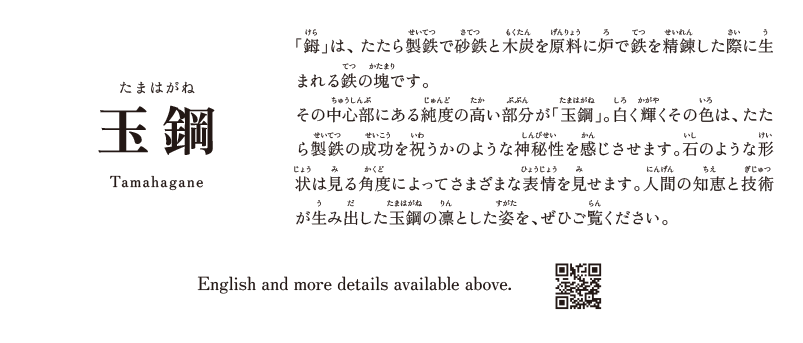
“Kera” is a lump of iron produced during the tatara ironmaking process, in which iron is refined
in a furnace using iron sand and charcoal as raw materials.
The high-purity portion at its center is called “tamahagane.” Its bright white color gives it a
mysterious appearance, as if celebrating the success of the kera ironmaking process. Its
stone-like shape reveals various expressions depending on the angle from which it is viewed.
Please take a moment to admire the dignified form of tamahagane, a product of human wisdom and
technology.
Okuizumo × Tatara Ironmaking
Japan’s Ancient Ironmaking Technique

Tatara ironmaking is a traditional Japanese ironmaking method that involves slowly refining iron
sand and charcoal in an earthen furnace.
This technique, which has a history of over 1,400 years, is said to be the origin of Japanese
manufacturing. In Okuchizukawa, Shimane Prefecture, where high-quality iron sand can be found,
tatara ironmaking has been actively practiced and has supported the domestic demand for
iron.
The Tanabe family, which began tatara ironmaking in 1460, exhibited iron at the Chicago and
Paris World's Fairs during the Meiji period, and its quality was highly praised worldwide.
Although it once ceased during the late Taisho period, it has been revived after approximately
100 years, and the traditional techniques and spirit are now embarking on a new journey.
The Iron Road

Iron produced in the Sanin region was mainly transported by sea, water, and horseback.
The Izumo Kaido was also used to transport iron sand and iron products to the Sanyo region, and
was nicknamed the “Iron Road.” Due to its contribution to the development of religion and
industry, there are many shrines and ruins related to iron production scattered around the Izumo
Kaido.
Sakai knives
The Mastery of Bladesmiths Creating the Ultimate Sharpness
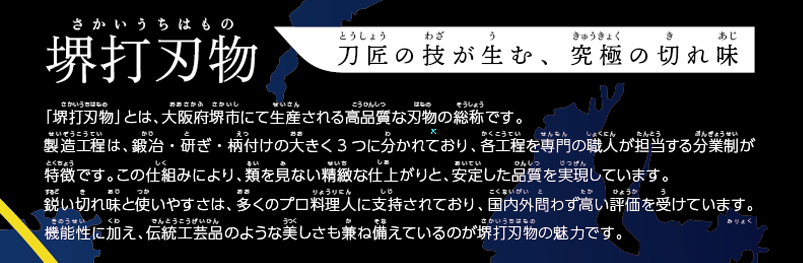
“Sakai knives” is a general term for high-quality cutlery produced in Sakai City, Osaka
Prefecture.
The manufacturing process is divided into three main stages: forging, sharpening, and handle
attachment, each handled by specialized craftsmen in a division of labor system. This system
enables unparalleled precision and consistent quality.
The sharp cutting performance and ease of use are highly regarded by many professional chefs,
earning high praise both domestically and internationally. In addition to functionality, the
beauty reminiscent of traditional crafts is another charm of Sakai-made cutlery.
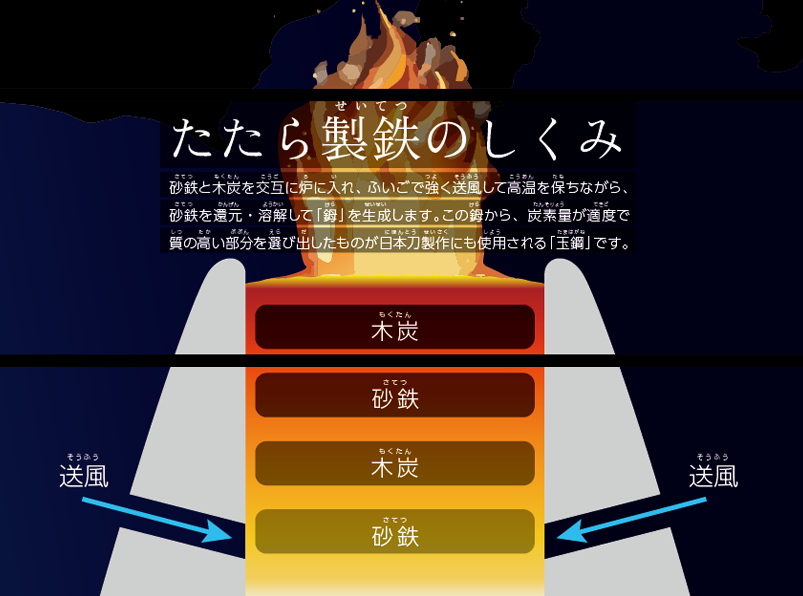
The Mechanism of Tatara Ironmaking
“Kera” is a lump of iron produced during the tatara ironmaking process, in which iron is refined
in a furnace using iron sand and charcoal as raw materials.
The high-purity portion at its center is called “tamahagane.” Its bright white color gives it a
mysterious appearance, as if celebrating the success of the kera ironmaking process. Its
stone-like shape reveals various expressions depending on the angle from which it is viewed.
Please take a moment to admire the dignified form of tamahagane, a product of human wisdom and
technology.
charcoal / iron sand / air blast
Japan to the World

Tatara ironmaking uses iron sand and charcoal to produce iron. This iron is then used to make
high-purity tamahagane steel.
The craftsmanship of Sakai cutlery makes the most of this tamahagane steel.
These two traditional Japanese industries continue to evolve today, with their techniques being
passed down from generation to generation by skilled craftsmen.
We will share the reliable techniques and beauty that have been passed down through the ages
with the rest of the world.
Sakai knives
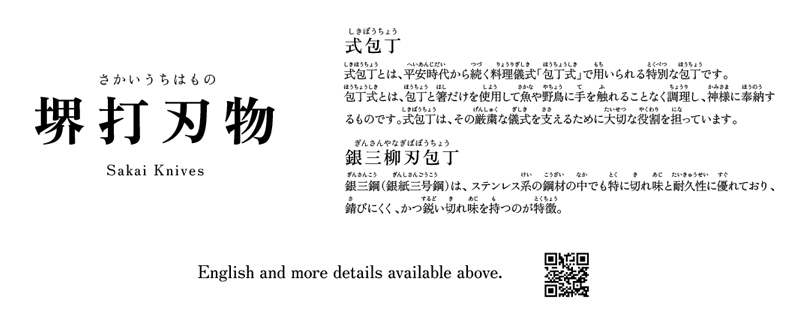
Ceremonial Kitchen Knife (Shiki-bōchō)
The shiki-bōchō is a special kitchen knife used in the traditional culinary ritual known as
hōchō-shiki, which has been practiced since the Heian period. In this ritual, food such as fish
or wild birds is prepared without ever being touched by hand, using only a knife and chopsticks,
and then offered to the deities. The ceremonial knife plays an essential role in upholding the
solemnity of this ancient practice.
Ginsan Yanagiba Knife
Made from Ginsan steel (Silver #3 steel), this stainless steel material is renowned for its
exceptional sharpness and durability. It is resistant to rust while maintaining a keen cutting
edge, making it highly valued among professional kitchen knives.
Japanese kitchen knife made with tamahagane
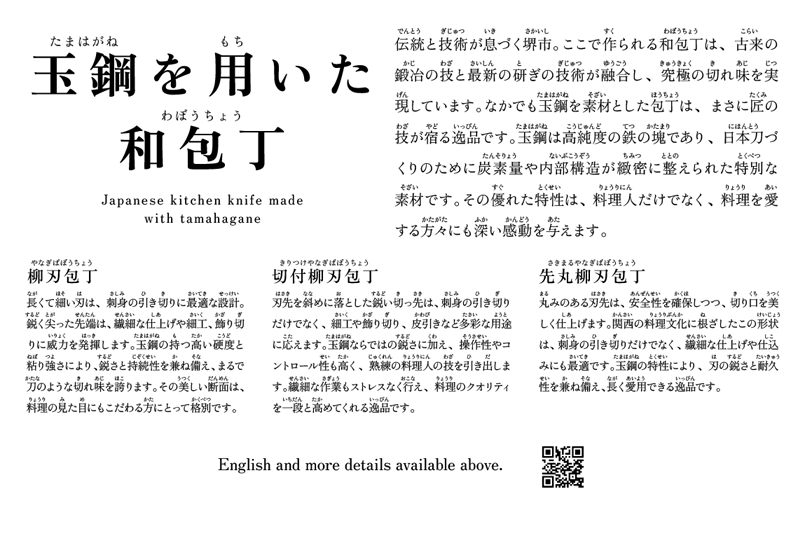
Sakai City, where tradition and technology thrive. The Japanese knives made here combine ancient blacksmithing techniques with the latest sharpening technology to achieve the ultimate in sharpness. Among these, knives made from tamahagane are truly masterpieces that embody the skills of master craftsmen. Tamahagane is a high-purity iron ingot, a special material meticulously crafted for Japanese sword making with precise carbon content and internal structure. Its exceptional properties inspire deep admiration not only among chefs but also among those who love cooking.
Yanagiba knife
The long, thin blade is designed for cutting sashimi. The sharp tip is powerful for delicate
finishing, carving, and decorative cutting. The high hardness and toughness of tamahagane steel
combine sharpness and durability, boasting a cutting edge like a sword. The beautiful
cross-section is exceptional for those who care about the appearance of their food.
Kiritsuke Yanagiba knife
The sharp blade, with its slanted cutting edge, is suitable for a wide range of uses, including
cutting sashimi, decorative cutting, and peeling. In addition to the sharpness unique to
tamahagane steel, it offers high operability and controllability, bringing out the skills of
skilled chefs. It allows you to perform delicate tasks without stress, and is an exceptional
product that will further enhance the quality of your cooking.
Sakimaru Yanagiba knife
The rounded blade tip ensures safety while producing a beautiful cut. Rooted in the culinary
culture of the Kansai region, this shape is ideal not only for cutting sashimi, but also for
delicate finishing touches and preparation work. The properties of tamahagane steel give the
blade both sharpness and durability, making it a gem that can be used for many years to come.